LangSmith is LangChain’s platform for debugging, testing, evaluating, and monitoring LLM applications.
Step 1: Get your LangSmith API key and Project name
In LangSmith, go to Settings > API Keys to create a new API key. Then navigate to your project or create a new one to get the project name.
Step 2: Enable Broadcast in OpenRouter
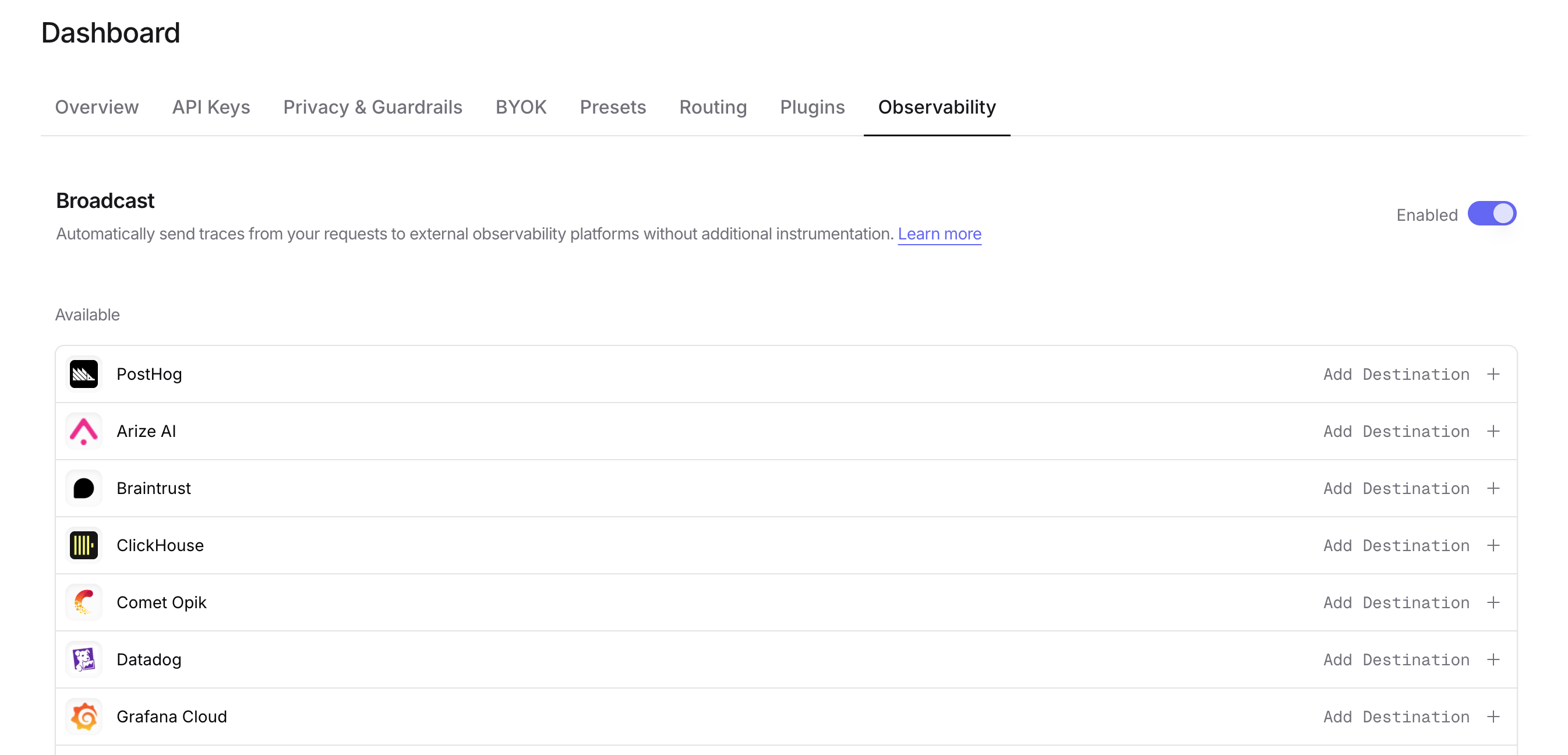
Go to Settings > Observability and toggle Enable Broadcast.
Click the edit icon next to LangSmith and enter:
- Api Key: Your LangSmith API key (starts with
lsv2_pt_...)
- Project: Your LangSmith project name
- Endpoint (optional): Default is
https://api.smith.langchain.com. Change for self-hosted instances
Step 4: Test and save
Click Test Connection to verify the setup. The configuration only saves if the test passes.
Step 5: Send a test trace
Make an API request through OpenRouter and view the trace in LangSmith. Your traces will appear in the specified project with full details including:
- Input and output messages
- Token usage (prompt, completion, and total tokens)
- Cost information
- Model and provider information
- Timing and latency metrics
What data is sent
OpenRouter sends traces to LangSmith using the OpenTelemetry (OTEL) protocol with the following attributes:
- GenAI semantic conventions: Model name, token counts, costs, and request parameters
- LangSmith-specific attributes: Trace name, span kind, user ID, and custom metadata
- Input and output: Prompt and completion content on the run as
langsmith.span.input / langsmith.span.output and gen_ai.prompt / gen_ai.completion. The root run no longer carries a duplicate copy under langsmith.trace.input / langsmith.trace.output.
- Error handling: Exception events with error types and messages when requests fail
LangSmith uses the OTEL endpoint at /otel/v1/traces for receiving trace data. This ensures compatibility with LangSmith’s native tracing infrastructure.
Example
Run Types
OpenRouter maps observation types to LangSmith run types:
- GENERATION →
llm run type
- SPAN →
chain run type
- EVENT →
tool run type
Additional Context
- The
user field maps to LangSmith’s User ID
- The
session_id field maps to LangSmith’s Session ID for conversation tracking
- Custom metadata keys are passed as span attributes and viewable in the run details
Privacy Mode
When Privacy Mode is enabled for this destination, prompt and completion content is excluded from traces. All other trace data — token usage, costs, timing, model information, and custom metadata — is still sent normally. See Privacy Mode for details.