Sentry is an application monitoring platform that helps developers identify and fix issues in real-time. With Sentry’s AI monitoring capabilities, you can track LLM performance and errors.
Step 1: Get your Sentry OTLP endpoint and DSN
In Sentry, navigate to your project’s SDK setup:
- Log in to your Sentry account
- Go to Settings > Projects > [Your Project] > SDK Setup > Client Keys (DSN)
- Click on the OpenTelemetry tab
- Copy the OTLP Traces Endpoint URL (ends with
/v1/traces)
- Copy your DSN from the same page
Step 2: Enable Broadcast in OpenRouter
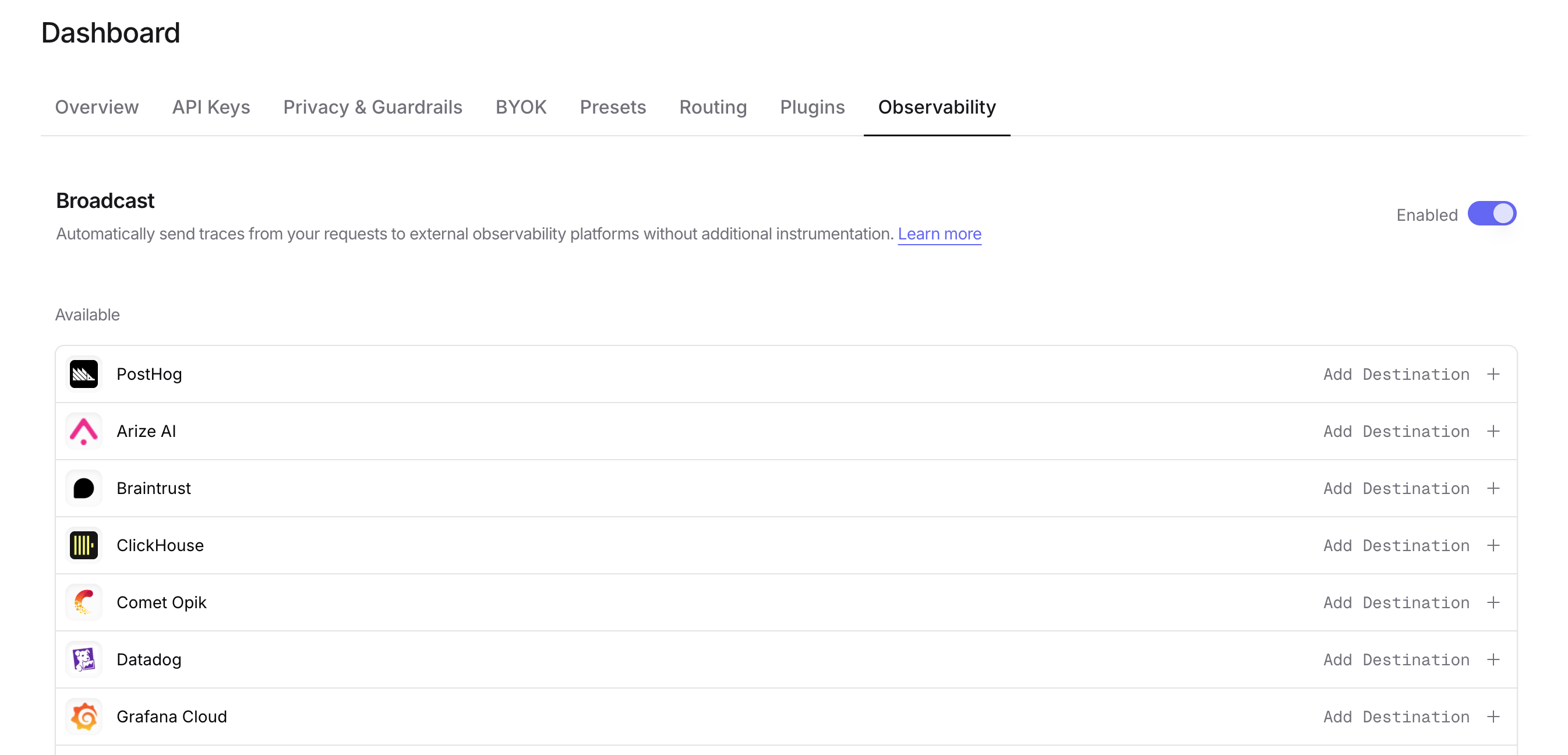
Go to Settings > Observability and toggle Enable Broadcast.
Step 3: Configure Sentry
Click the edit icon next to Sentry and enter:
- OTLP Traces Endpoint: The OTLP endpoint URL from Sentry (e.g.,
https://o123.ingest.us.sentry.io/api/456/integration/otlp/v1/traces)
- Sentry DSN: Your Sentry DSN (e.g.,
https://abc123@o123.ingest.us.sentry.io/456)
Step 4: Test and save
Click Test Connection to verify the setup. The configuration only saves if the test passes.
Step 5: Send a test trace
Make an API request through OpenRouter and view the trace in Sentry’s Performance or Traces view.
Sentry uses OpenTelemetry for trace ingestion. The OTLP endpoint and DSN are both required for proper authentication and trace routing.
trace field is sent as span attributes and can be used for filtering and analysis in Sentry’s Performance view.
Example
Additional Context
- Custom metadata keys from
trace are included as span attributes under the trace.metadata.* namespace
- The
user field maps to user.id in span attributes
- The
session_id field maps to session.id in span attributes
- Sentry automatically correlates LLM traces with your application’s existing error and performance data when using
parent_span_id
Privacy Mode
When Privacy Mode is enabled for this destination, prompt and completion content is excluded from traces. All other trace data (token usage, costs, timing, model information, and custom metadata) is still sent normally. See Privacy Mode for details.