Snowflake

Send traces to Snowflake

Snowflake is a cloud data warehouse platform. OpenRouter can stream traces directly to your Snowflake database for custom analytics, long-term storage, and business intelligence.

Step 1: Create the traces table

Before connecting OpenRouter, create the OPENROUTER_TRACES table in your Snowflake database. You can find the exact SQL in the OpenRouter dashboard when configuring the destination:
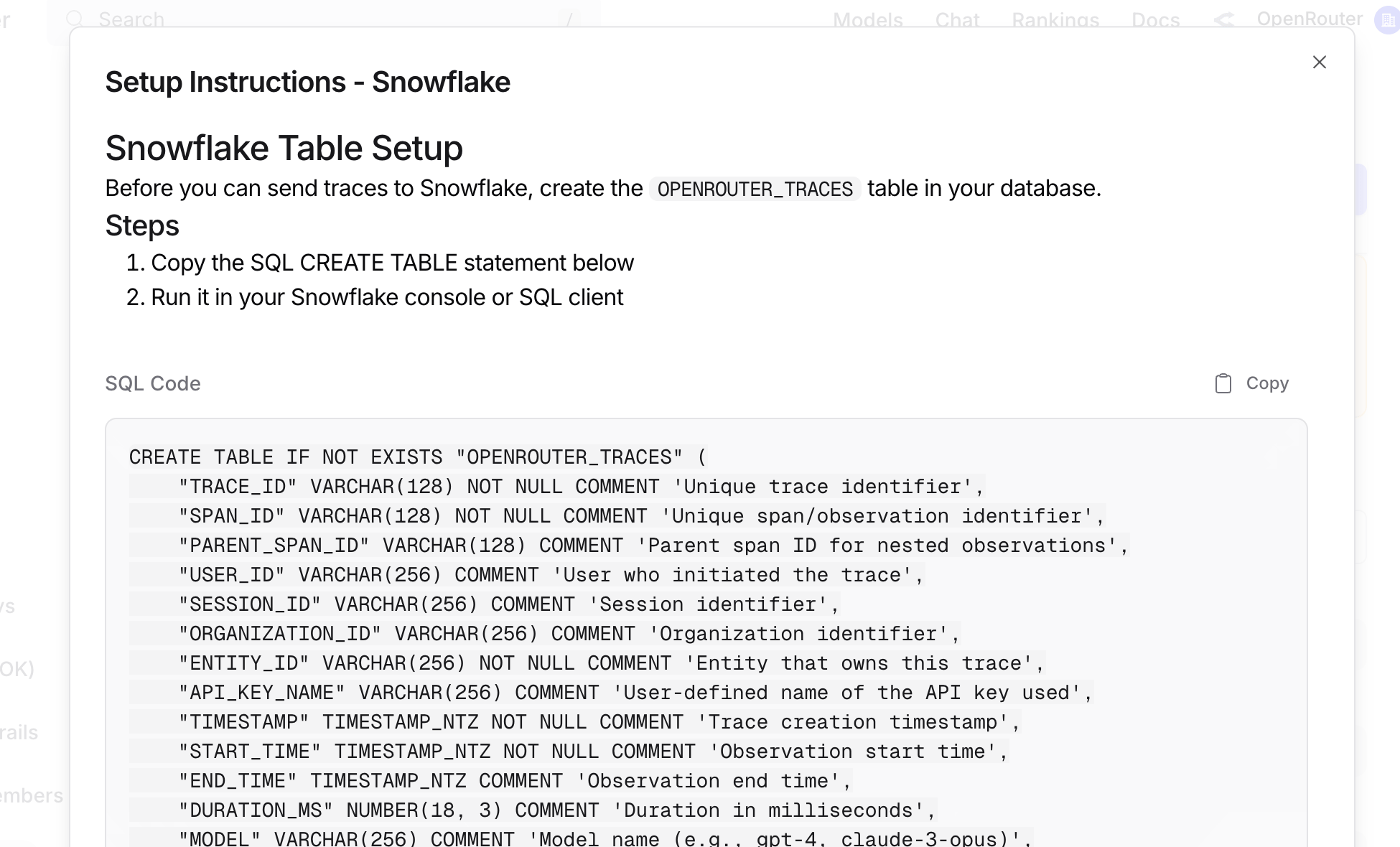
Snowflake Table Setup

Step 2: Create access credentials

Generate a Programmatic Access Token with ACCOUNTADMIN permissions in the Snowflake UI under Settings > Authentication.
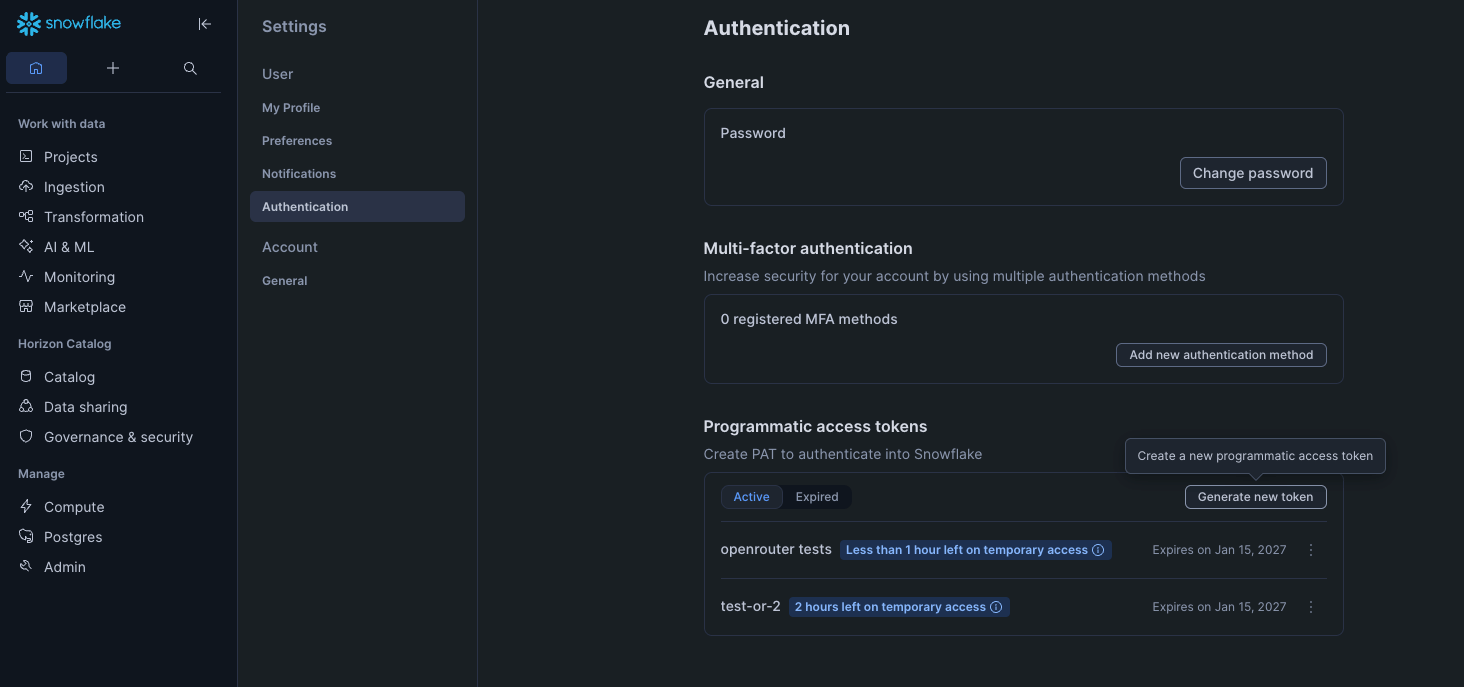
Snowflake PAT

Step 3: Enable Broadcast in OpenRouter

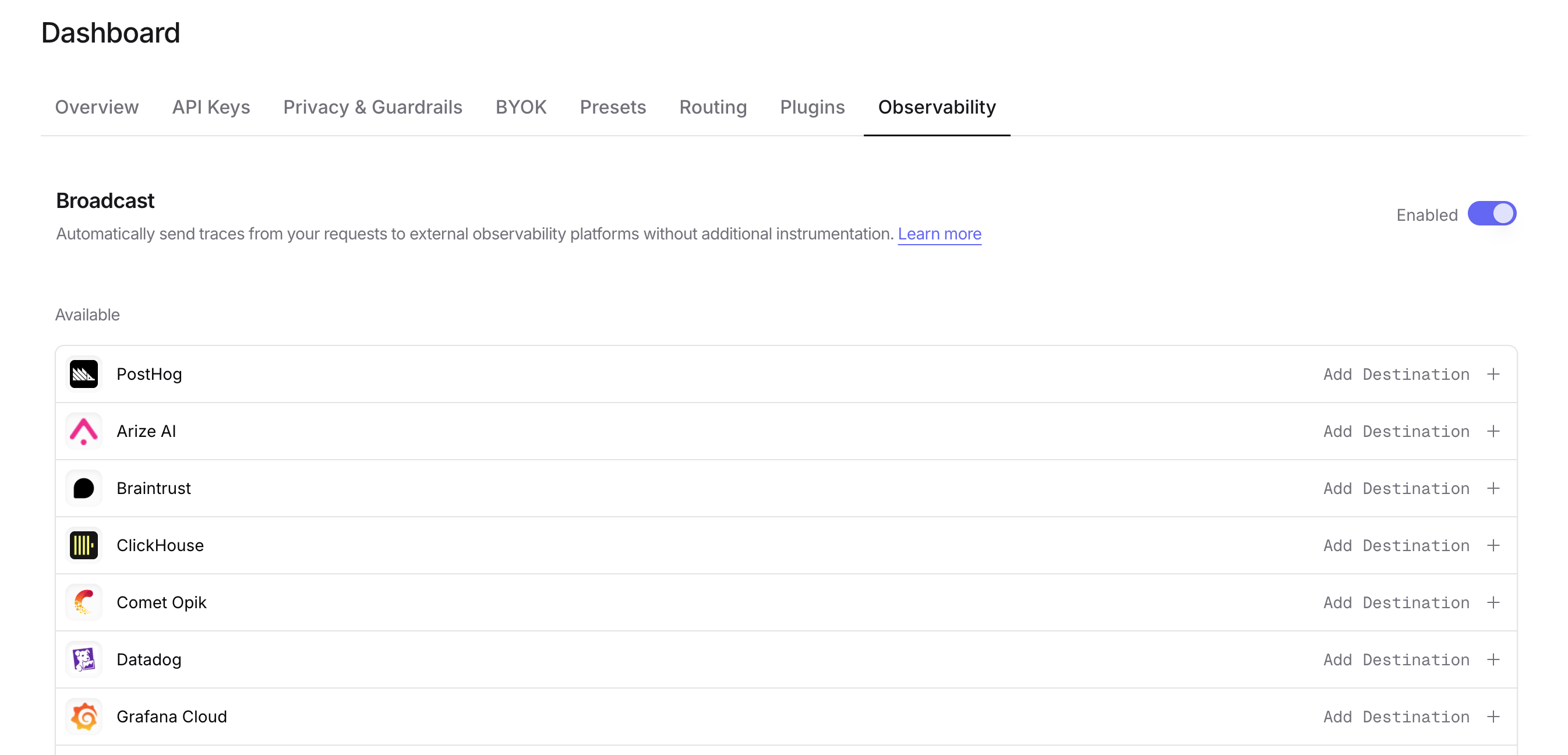
Go to Settings > Broadcast and toggle Enable Broadcast.

Enable Broadcast

Step 4: Configure Snowflake

Click the edit icon next to Snowflake and enter:

  • Account: Your Snowflake account identifier (e.g., eac52885.us-east-1). You can find your account region and your account number at the end of your Snowflake instance’s URL: https://app.snowflake.com/us-east-1/eac52885; together these make your account identifier.
  • Token: Your Programmatic Access Token.
  • Database: Target database name (default: SNOWFLAKE_LEARNING_DB).
  • Schema: Target schema name (default: PUBLIC).
  • Table: Table name (default: OPENROUTER_TRACES).
  • Warehouse: Compute warehouse name (default: COMPUTE_WH).

Step 5: Test and save

Click Test Connection to verify the setup. The configuration only saves if the test passes.

Step 6: Send a test trace

Make an API request through OpenRouter and query your Snowflake table to verify the trace was received.
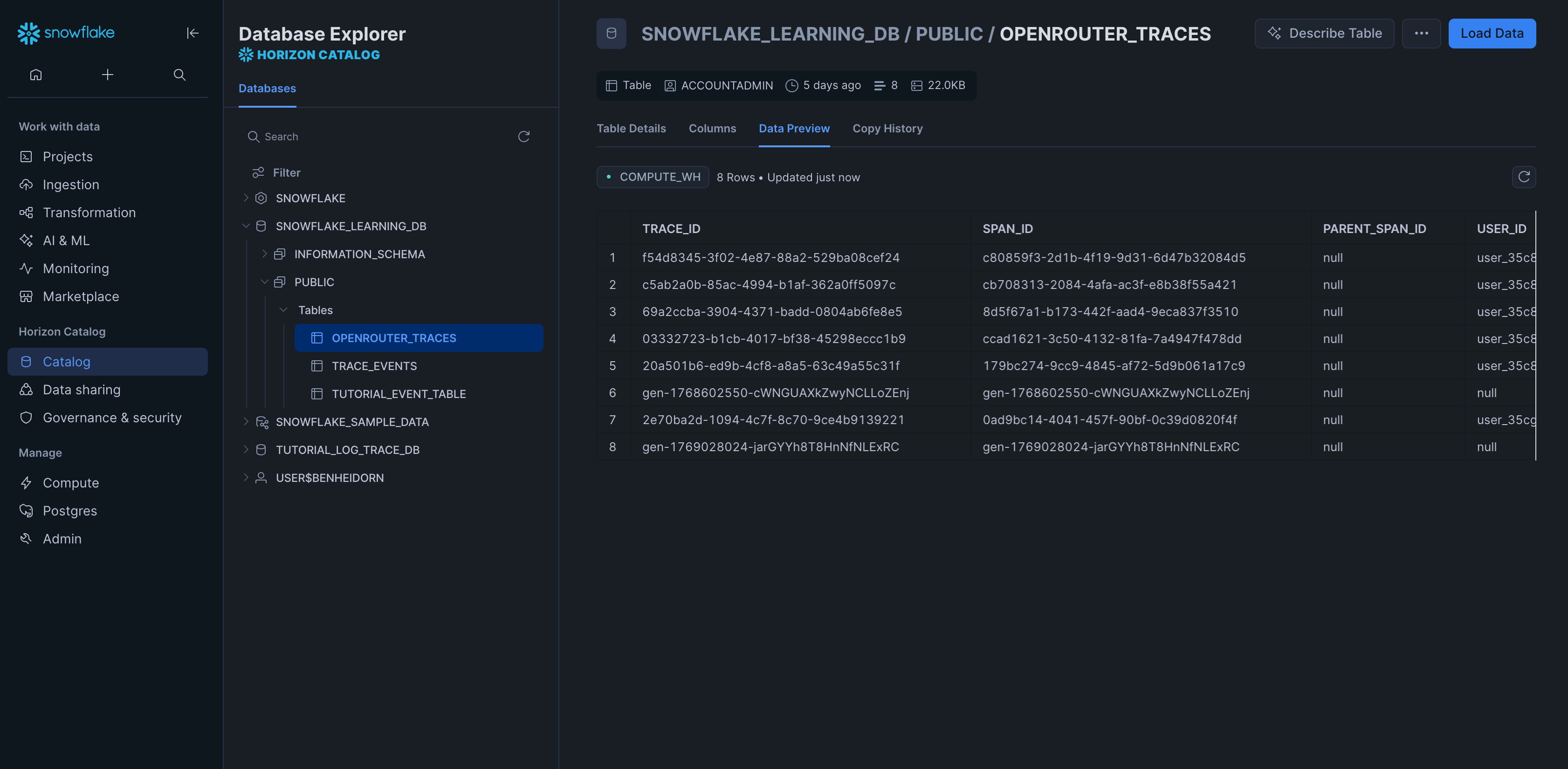
Snowflake Test Trace

Example queries

Cost analysis by model

1SELECT
2 DATE_TRUNC('day', TIMESTAMP) as day,
3 MODEL,
4 SUM(TOTAL_COST) as total_cost,
5 SUM(TOTAL_TOKENS) as total_tokens,
6 COUNT(*) as request_count
7FROM OPENROUTER_TRACES
8WHERE TIMESTAMP >= DATEADD(day, -30, CURRENT_TIMESTAMP())
9 AND STATUS = 'ok'
10 AND SPAN_TYPE = 'GENERATION'
11GROUP BY day, MODEL
12ORDER BY day DESC, total_cost DESC;

User activity analysis

1SELECT
2 USER_ID,
3 COUNT(DISTINCT TRACE_ID) as trace_count,
4 COUNT(DISTINCT SESSION_ID) as session_count,
5 SUM(TOTAL_TOKENS) as total_tokens,
6 SUM(TOTAL_COST) as total_cost,
7 AVG(DURATION_MS) as avg_duration_ms
8FROM OPENROUTER_TRACES
9WHERE TIMESTAMP >= DATEADD(day, -7, CURRENT_TIMESTAMP())
10 AND SPAN_TYPE = 'GENERATION'
11GROUP BY USER_ID
12ORDER BY total_cost DESC;

Error analysis

1SELECT
2 TRACE_ID,
3 TIMESTAMP,
4 MODEL,
5 LEVEL,
6 FINISH_REASON,
7 METADATA as user_metadata,
8 INPUT,
9 OUTPUT
10FROM OPENROUTER_TRACES
11WHERE STATUS = 'error'
12 AND TIMESTAMP >= DATEADD(hour, -1, CURRENT_TIMESTAMP())
13ORDER BY TIMESTAMP DESC;

Provider performance comparison

1SELECT
2 PROVIDER_NAME,
3 MODEL,
4 AVG(DURATION_MS) as avg_duration_ms,
5 PERCENTILE_CONT(0.5) WITHIN GROUP (ORDER BY DURATION_MS) as p50_duration_ms,
6 PERCENTILE_CONT(0.95) WITHIN GROUP (ORDER BY DURATION_MS) as p95_duration_ms,
7 COUNT(*) as request_count
8FROM OPENROUTER_TRACES
9WHERE TIMESTAMP >= DATEADD(day, -7, CURRENT_TIMESTAMP())
10 AND STATUS = 'ok'
11 AND SPAN_TYPE = 'GENERATION'
12GROUP BY PROVIDER_NAME, MODEL
13HAVING request_count >= 10
14ORDER BY avg_duration_ms;

Usage by API key

1SELECT
2 API_KEY_NAME,
3 COUNT(DISTINCT TRACE_ID) as trace_count,
4 SUM(TOTAL_COST) as total_cost,
5 SUM(PROMPT_TOKENS) as prompt_tokens,
6 SUM(COMPLETION_TOKENS) as completion_tokens
7FROM OPENROUTER_TRACES
8WHERE TIMESTAMP >= DATEADD(day, -30, CURRENT_TIMESTAMP())
9 AND SPAN_TYPE = 'GENERATION'
10GROUP BY API_KEY_NAME
11ORDER BY total_cost DESC;

Accessing VARIANT columns

1SELECT
2 TRACE_ID,
3 METADATA:custom_field::STRING as custom_value,
4 ATTRIBUTES:"gen_ai.request.model"::STRING as requested_model
5FROM OPENROUTER_TRACES
6WHERE METADATA:custom_field IS NOT NULL;

Parsing input messages

1SELECT
2 TRACE_ID,
3 INPUT:messages[0]:role::STRING as first_message_role,
4 INPUT:messages[0]:content::STRING as first_message_content
5FROM OPENROUTER_TRACES
6WHERE SPAN_TYPE = 'GENERATION';

Schema design

Typed columns

The schema extracts commonly-queried fields as typed columns for efficient filtering and aggregation:

  • Identifiers: TRACE_ID, USER_ID, SESSION_ID, etc.
  • Timestamps: For time-series analysis
  • Model Info: For cost and performance analysis
  • Metrics: Tokens and costs for billing

VARIANT columns

Less commonly-accessed and variable-structure data is stored in VARIANT columns:

  • ATTRIBUTES: Full OTEL attribute set
  • INPUT/OUTPUT: Variable message structures
  • METADATA: User-defined key-values
  • MODEL_PARAMETERS: Model-specific configurations

This design balances query performance with schema flexibility and storage efficiency.

Custom Metadata

Custom metadata from the trace field is stored in the METADATA VARIANT column. You can query it using Snowflake’s semi-structured data functions.

Supported Metadata Keys

KeySnowflake MappingDescription
trace_idTRACE_ID column / METADATA:trace_idCustom trace identifier for grouping
trace_nameMETADATA:trace_nameCustom name for the trace
span_nameMETADATA:span_nameName for intermediate spans
generation_nameMETADATA:generation_nameName for the LLM generation

Example

1{
2 "model": "openai/gpt-4o",
3 "messages": [{ "role": "user", "content": "Forecast next quarter revenue..." }],
4 "user": "user_12345",
5 "session_id": "session_abc",
6 "trace": {
7 "trace_name": "Revenue Forecasting",
8 "generation_name": "Generate Forecast",
9 "department": "finance",
10 "quarter": "Q2-2026",
11 "model_version": "v3"
12 }
13}

Querying Custom Metadata

Use Snowflake’s VARIANT column syntax to query your custom metadata:

1SELECT
2 TRACE_ID,
3 METADATA:department::STRING as department,
4 METADATA:quarter::STRING as quarter,
5 METADATA:model_version::STRING as model_version,
6 TOTAL_COST,
7 TOTAL_TOKENS
8FROM OPENROUTER_TRACES
9WHERE METADATA:department IS NOT NULL
10 AND SPAN_TYPE = 'GENERATION'
11ORDER BY TIMESTAMP DESC;

Additional Context

  • The user field maps to the USER_ID typed column
  • The session_id field maps to the SESSION_ID typed column
  • All custom metadata keys from trace are stored in the METADATA VARIANT column for flexible querying
  • You can create materialized views on frequently queried metadata fields for better performance

Privacy Mode

When Privacy Mode is enabled for this destination, prompt and completion content is excluded from traces. All other trace data — token usage, costs, timing, model information, and custom metadata — is still sent normally. See Privacy Mode for details.